Showing posts with label backpack. Show all posts

Wednesday, 7 December 2011

A Final Message from Mumbai

Every journey moves inexorably to the point that I am currently facing. With every passing day, every steady minute and every fleeting second, that point in time is brought ever closer. And finally, it's presence becomes so apparent that you are forced to adjust your course to meet it. The end.

A point in time with such startling finality. Each of my every-day actions became somewhat more noticeable, more pointed. The simple act of donning my closed shoes, which previously lay forgotten at the bottom of my bag, had such obvious clarity of being the first time I had done so since removing them two months ago. It was a signal of my leaving, my imminent return home. I was struck by the thought that all of this, these experiences and memories, would be just that - memories and experiences - as soon as I leave. The immediacy of being here is condemned to be lost.

My Indian journey has been a true rollercoaster ride of experience. I have felt defeated by the crazy systems and masses of people. I have struggled to find my way and felt out of place. But I have also laughed at the crazy systems, got back on track and found a groove in which I fit. India seemed to fight against me at every possible moment at the start of my trip, and the craziness got the better of me. I felt swamped and overpowered, struggling to make sense of this amazing place. It was loud, fast and overbearing. It was the freezing cold water that I didn't let get past my ankles when the best course of action was just to jump in. I stood at the water's edge for a long while, afraid of the leap required, resisting it, until finally I relented. I immersed myself in India and found that the water was not as cold as I had imagined, or feared. It was refreshing and invigorating. I was instilled with a sense of vibrancy and awareness. I woke up to the wonders of this incredible country.

And now, what seems like such a short time after my awakening, I am forced to say goodbye to India. I have to let go of the country and cling tightly to the memories it has given me. Each place I visited and every person I met will be remembered. I will cherish the memories of all the times I laughed and all the times I felt despair. I will hold on to the fleeting memories of the sights and sounds, the smells and the tastes that so defined my experience.

I must leave India, but I leave knowing I will be back. In my two months of travel I feel that I've barely scratched the surface of what India has to offer. This vast chunk of land holds so much more for me to explore, to learn, to witness.

I must leave India, but I leave changed. India has altered my perspectives and adjusted my views. India has opened my mind to so much more. There is still so much to see and do, and barely enough time to see and do it. A world awaits me...

Tuesday, 29 November 2011

Old Goa and the Goa of Old

There comes a point in every travelers life that he must get off his arse and type up a blog post to keep the people who read it informed about his whereabouts. That time, for me, has come. I've been putting off typing up another blog post for the reason that there won't be many blog posts left to write after this one. The truth is that there's precious little time left for me in this marvelous country and if I catch up with my writing there'll be almost nothing left to write about.

But I must catch up.

If you're wondering where I am at the moment, I will tell you. I am in the diminutive town of Chapora - the Goa of Old. A quaint, one-street town which is a favourite Goa's hippy scene. But I'm getting ahead of myself. Before I write about the Goa of Old I must first write about how I got here. And getting here was preceded by a trip to Old Goa. If this doesn't make sense yet, bear with me - it soon will.

Old Goa was the capital of Goa during the era of Goa's Portuguese occupation. It is now pretty much a ghost town. What was once a thriving city at the height of the Portuguese rule is now just a husk of a town. The only buildings which remain are the churches and cathedrals which serve as a testament to the Catholic influence which differentiates Goa from other Indian states. Old Goa is also a convenient 15 minute bus ride away from Panaji, making it a perfect day trip for the travel enthusiast. Well, almost perfect.

Se Cathedral
Old Goa was definitely worth the visit and the churches and cathedrals were large and numerous, but it failed to excite me. I suppose that was partially due to the crowds of other tourists who got bussed straight in, and partly because Old Goa gave off an air of discomfort. It's quite difficult to explain, but Old Goa felt as if it didn't belong in India, in Goa even. Everywhere you looked you were confronted by another massive, out-of-place church. The churches dominated the area and I couldn't help but feel that it was all intended as a display of dominance by the Portuguese. The imposing structures seemed to be built to be formidable. It all felt like a religious prick-waving contest that got seriously out of hand.

Churches aren't my thing, but I do love a good beach. And so, with the beach beckoning I left Panaji and headed north to Anjuna. Anjuna is another stalwart of the old hippy scene and used to have a reputation as the place to go to experience a Goan trance party. I imagine things have calmed down since then because I only caught wind of one party happening and the next day everyone said it got closed down at 11 PM.

The sunset over Anjuna
Anjuna may not be the place to go for a party anymore, but it is a great spot to go for a swim. For once the waves were of a moderate size and could be bodysurfed, unlike anywhere else in Goa. That said, waiting for the waves of a moderate size that could be bodysurfed seemed to take up most of the time that I spent in the water. At this point you can probably deduce where this blog post is going to go. Yep, nowhere. When you're spending most of the day on a beach there's not much to write home about.

I did visit the Mapusa Friday market for a couple of hours, but it turned out to be a bit of a disappointment. What was on sale was mostly just tourist crap and fish. I did scour the market for anything interesting or different, but all of the places were selling the same slew of tourist trash - trinkets and T-shirts mostly.

Funnily enough I decided that Anjuna wasn't the best place to be staying. I'm not sure why I came to that conclusion, but it made sense in my mind at the time. I decided to move on after only a few days of lazing on the beach. I even moved away from the beach - to Chapora.


Chapora is a forgotten town. Forgotten by
tourists, at least
The Lonely Planet likens Chapora to the Mos Eisley Canteen in Star Wars and when I arrived here I understood why. It's not much bigger than a canteen, for a start, and its residents (local and hippy alike) have a very relaxed and slow pace of life. That might have something to do with the charas those hippies are smoking, but I can't be certain. It is the Goa of Old and that's what makes it an attractive place to stay. Chapora has not grown up with the rest of Goa. Everywhere else in Goa is full of tourists, Chapora has only a light sprinkling - and most of them are long-stayers. Chapora is still decidedly cheap, whereas the rest of Goa has hiked its prices up to milk the package tourists. I like Chapora. It's just what I was looking for, an almost untainted Goa, a lack of other tourists.

There's nothing to do in Chapora, nothing pressing at least. And I can't help but like that about it. I can spend a full day sipping chai and reading a book and not have to worry that I'm being slack because there's nothing else to do. I think I might just get stuck here for a while...
A short walk from Chapora - Vagator beach

Tuesday, 22 November 2011

On Indians

Spending every day on a beach for a week is fantastic, but doing so means there's precious little to share with you, the readers of my blog. I thought I'd take a different angle with this post and attempt to describe the Indian people. This may make no sense whatsoever, but if it does it would be a fitting description of Indian people as a whole.

I'll start off by saying that to group all Indians together and try to describe them as a single people (which is my plan) is a ridiculous notion. The people are different everywhere you go, sometimes only marginally, other times drastically.

Indians never cease to amaze and amuse me and occasionally shock me into silence. I am constantly amazed by the warmth that the people of this fine country exhibit. Everywhere I go I encounter people smiling broadly and laughing loudly. The happiness is contagious and I've often had to stop my self grinning like a maniac while walking down a busy street, garnering funny looks from the laughing locals. Laughs, smiles and jokes are a way of life in India, and yet I'm always left wondering - why?

India's economy is booming, and that is a gross understatement. The new wealth in India is remarkable, staggering even. India is going places, fast. New money is everywhere, it is flaunted and put on display, mostly garishly. It's not enough just to be wealthy, one's wealth must be flaunted at every possible occasion. There is this crazy urge to be seen to be wealthy.. A crazy urge which seems to be killing the smiles and laughs and jokes. Yes, the smiles are still there, ditto the laughs, but they're different - hollow. In public, the wealthy laugh too loudly and speak too loudly. Trying, it seems, to draw attention to themselves, to show a carefree side which probably no longer exists.

It seems to me that the happiest Indians are those who don't have all that pressure of wealth placed upon their shoulders. The rickshaw-wallahs, dabba-wallahs and chai-wallahs. The people who are still surprised to see foreigners and are eager to have their pictures taken with them. The laughs from them seem genuine, the smiles truly happy. These are the people of the India of old, before the craziness of the dash for riches permeated their society. These are the people I love to meet. Those who have so little always seem to have the most to give.

I'll deviate now to something which I find very peculiar - the India-Pakistan relationship. Leaving aside all the history between these two nations I'd like to discuss a strange reaction I got when I asked an Indian man about his thoughts on the relationship. A little background though - this man is from Pune (a city about an hour from Mumbai, fairly large and progressive), he grew up in Mumbai in a fairly well-off family and after school set about making himself a lot of money. He is not incredibly rich, like some Indians, but he is rich enough to want to be seen to be rich. His brother-in-law is a high-ranking army officer.

When I asked him about what he thought about Pakistan this was his exact response:
"I'm telling you, If  I ever meet a Pakistani... or a Bangladeshi... I will slap him in the face!"
I was shocked! Such raw hatred for an entire country of people. I wanted to know why. I asked him...
"I know it's the 20 which give the other 80 a bad name, but I don't care, if I ever see a Pakistani I will slap him in the face!"
More shock! The 20 which give the other 80 a bad name. Here he was, happily admitting that the whole of Pakistan is not to blame for the animosity between these two countries, but that wouldn't stop him from physically assaulting a Pakistani person unlucky enough to come across him. I find the mutual hatred these countries have for each other astounding. Hatred for each other is ingrained in the societies to the extent that even a man from progressive Mumbai would happily attack his counterpart from Islamabad. This is not the way the world should work.

That conversation made a huge impact on me. It took me completely by surprise. I was suddenly left questioning if everyone felt this way. Could a people so outwardly happy harbour such hatred for other people? Even my favourite Indianisms lost there flavour for a while.

The flavour quickly returned, though. But you're probably wondering what the hell an Indianism is. It's an Oliver Goosen invention, that's what it is. India is full of Indianisms. They are, by definition, very funny and distinctly Indian. An example of an Indianism would be talking to someone about cricket and the topic of Sachin Tendulkar pops up (as it inevitably does), "He is the maximum best batsmen in the world, my god!"
Say that with a pseudo-Indian accent and place emphasis on the underlined words and you'll see what I'm getting at. Indianisms are everywhere, in the way Indians speak, advertise and joke especially. Indiansims stem from the almost childlike way that Indians speak. I don't mean that in a condescending way at all, I just think it's oddly charming. When you've sat next to someone who describes a cricket shot as 'ultra-powerful, hyper-goodlooking' you'll know what I mean.

Indianisms are best experienced so I'll share with you a few of my favourites.

On the side of a road I spotted a cement factory. The building proudly displayed a sign which read: "Cement produced with robot technology!"
I was astounded! Here, in a random location in India, robots where making the cement for new buildings. What sheer brilliance, what incredible ingenuity!

I spotted another fantastic Indianism in a bus earlier today. Innocuously hidden just below a No Smoking sign were the words: 'NO SPITING!' I was lucky I spotted that because I had a spiteful comment lined up for the guy next to me who kept extending his seat space by stealing mine. But seeing as spitting wasn't prohibited I decide to mark out my territory with my saliva...

My all-time favourite Indianism comes from quite a large brand of... something... I'm not even sure what they're selling, but their name is one for the records. They trade under the fantastic title of Bumchums, and they advertise everywhere! I get some strange looks from locals every time I come across one of their signs. They all look at me and I can see them thinking, "What the fuck is that guy laughing about?"

Wednesday, 16 November 2011

Sossegado

Writing this blog post is going to be hard work. Not because writing blogs is particularly hard, but because my fingers, and perhaps the rest of my body, have gone into a semi-comatose state brought about by the Goan beaches.

Palolem is a beach
My long train trip is over. All 38 hours of it. The train spat me out in the city of Margao in the south of Goa and I promptly caught a bus further south, to Palolem. Palolem is a beach town. It is is a beautiful beach town. It is, in fact, more of a beach than a town. The beach is, in essence, the town. Palolem is a beach. There are huts on the beach with people in them. And bars on the beach with other people in them. There are palm trees around the beach and a flat sea just off the beach. The beach is crescent-shaped, which is apparently a good shape for a beach to be. It is hot. It is sunny. There is a certain sossegado to life on this beach.

Sossegado is a distinctly Goan word. It translates, rather crudely, to laid-backness. It is undeniably the best word to describe life in a Goan beachside town. Life is just laid-back. There's not much to do but lie in the sun (or the shade, if you're a pasty individual like me who doesn't want to look like a burnt tomato at the end of the day) and read. And then spend some time in the balmy water. Because there's not much to do apart from be a lazy lout and enjoy yourself, there's not much to write about to interest other people in an obscure, traveler's blog post. Which is the reason I'm citing for not having written anything, up to now. I assure you it has everything to do with me being too lazy to remove myself from the beach and type something up.

Three paragraphs in and I've managed to say nothing at all. This is a pretty good sign. It looks like I'll be able to pass off my laziness by obscuring it in florid descriptions of beaches and palm trees.

This is my Palolem beach hut - swanky, right?
One remarkable thing about accommodation in Palolem is the accommodation itself. Almost all of the accommodation is of the tiny, beach hut variety, just off the beach, amongst the palm trees. These little huts are fantastic! They are assembled at the beginning of each tourist season, just after the monsoon, and disassembled at the end of each season, before the monsoon's return. Huts are pokey, with little more than a bed and a mosquito net (and a tiny bathroom, if you're lucky) which is exactly why I love them. Waking up in a rickety little hut and stumbling out on to a beach is a brilliant way to start a day. If you haven't experienced this, you'll have to take my word for it. Another brilliant feature of these little huts is the maze of sandy, shady alleyways that get formed between them. A walk along these narrow paths is a good way to step away from the countless European tourists in Speedos who inhabit the beach. Speedo's should be considered a crime against humanity.
I wake up to this...

Patnem, a semi-Speedo-free zone
A little way south of Palolem is another beach, Patnem. Patnem is also a crescent-shaped beach, but with the added advantage of having fewer Speedo-toting Europeans around. It's a lot less busy and is therefore a good way of escaping the tourist hordes. I spent some time there today, and I plan on spending some more time there tomorrow, and the next day. Anything to save my eyes from that horrible excuse for a swimming costume. And the people who seem to think it's a very attractive swimming costume. These people are almost always fat, roasted men in their late fifties from the south of France.

With the conclusion of my rant on the heinous crime that is wearing a Speedo in public, or even in private for that matter, I think I'll conclude this pointless update of my blog. You are now aware of my laziness. My confirmation of it is firmly in writing. It's starting to approach evening time over here, the sun is well over the yardarm. I'm going to be heading back to the beach soon to enjoy a cold beer and a spicy, prawn vindaloo.

Oh God, those vindaloos... The mouth-watering explosion of flavour that is the Goan specialty dish. The spices, the fresh seafood which practically swam on to the plate, the zing of chilli... The sudden reverie that merely typing the word 'vindaloo' induces...

I'm off... I think I'll have an early supper.

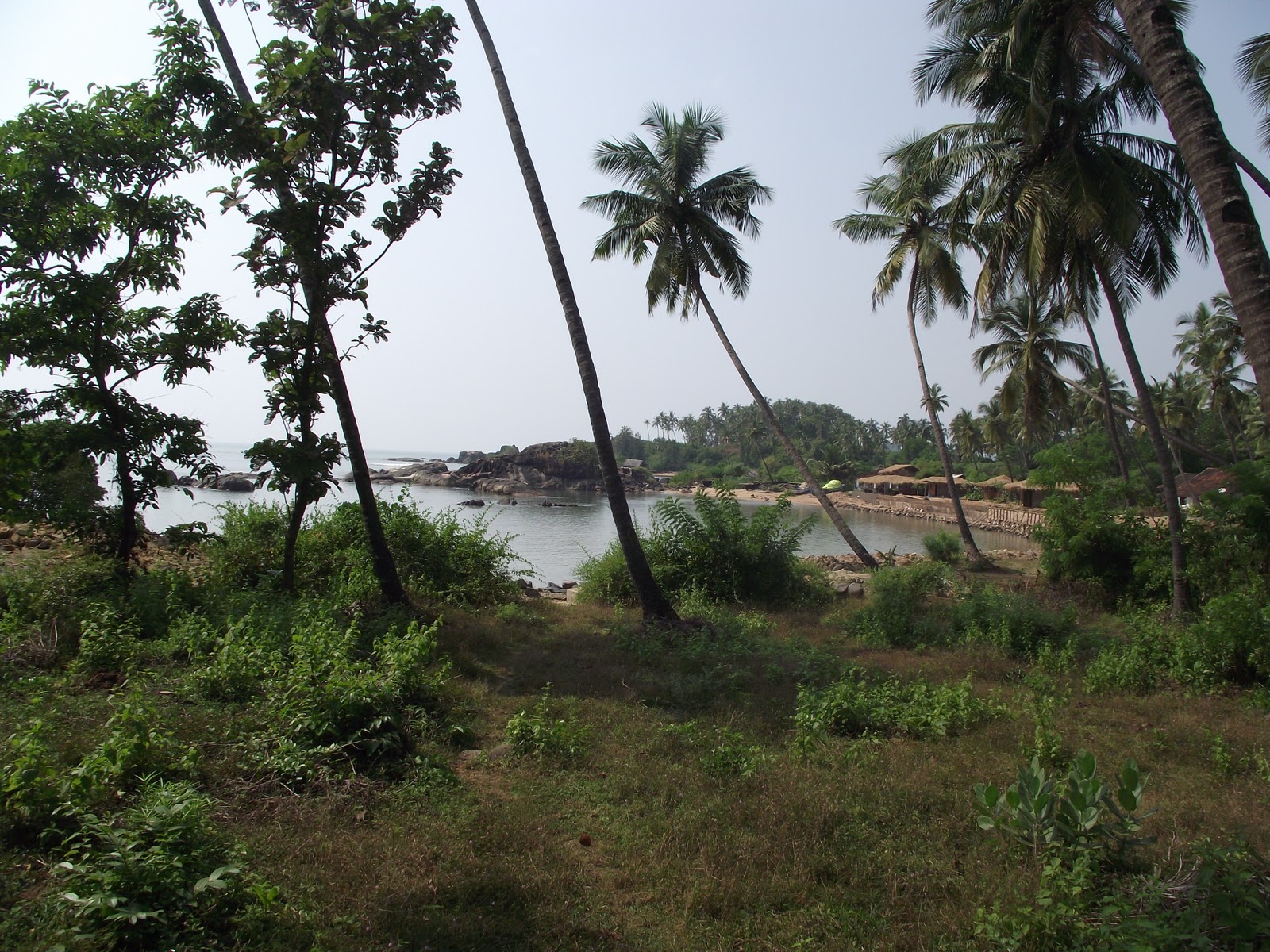
A snapshot of the rocky Colomb bay

Sunday, 6 November 2011

Only in India

A few recent events have led me to give this post that title. And it's theme. I'm going to dedicate this post to things you'll probably only encounter in India.

Since day one I've witnessed events that, in other countries, would be considered strange at the very least. Although I'm sure that many of these events do happen elsewhere, just out of the view of everyone else. I'll start off small...

One thing you're likely only to witness in India is someone else's morning ablutions... outside... in the gutter... of a busy street. Yes, sadly I've had to witness this. And when I say witness, I mean I was there when it happened. I didn't walk by later and see the evidence. It's pretty rough, and it's made even more rough by the fact that nobody else seems to notice. People seem blissfully unaware as to what is happening just a few feet away. I put this down to the fact that there are almost no public toilets to speak of in India. For example, in Mumbai (a city with a population of nearly 17 million people) there are only about 300 public toilet facilities.

Varanasi and the Ganges
Moving on. Varanasi is a very holy city for Hindus. Dying in Varanasi allows a believer to be freed from the eternal cycle of death and rebirth. It comes as no surprise, then, that Varanasi is a very auspicious place to die and death is very much a part of life (uhh...) in Varanasi. After a long overnight train trip I arrived in Varanasi and made my way through a warren of little alleys to the guest house at which I'd be staying. On my way I heard chanting coming from behind me. I turned around and saw a body being carried down to the burning ghat for cremation, wrapped in a white cloth, head bobbing as it was whisked off to the pyres. Only in India.

Staying on the topic of dead people - a boat trip on the Ganges... While most people who die in Varanasi get a flaming send-off, others are not so lucky. Young girls, pregnant women and lepers don't get burnt at the funeral pyres. I'm not sure why although a guy did mention it had something to do with the young girls and foetuses being innocent. I'm not sure about the lepers though. Anyway, those who don't get burnt have a somewhat different send-off. They get wrapped up in a white cloth, tied to a huge boulder and dropped in the deepest part of the Ganges. Nice. The ropes they use to tie the bodies to the boulders are notoriously weak and it's not uncommon to see a body floating down the Ganges. Which brings me to my boat trip. You can't visit Varanasi and get away without taking a paddle up and down the Ganges, and perhaps watching a puja along the way. I went on a cruise of the Ganges and guess what bobbed past...
Yes, you guessed it - a body. Wrapped in a white cloth and looking decidedly displeased about being released by it's boulder. But it had to make an appearance on Halloween, right?

This last one could happen anywhere, and probably does. But the fact that it happened in India, while I was watching, afforded me the opportunity to shake my head in disbelief and say, "Only in India."
I was sitting in the exact spot I'm sitting now, in an Internet Cafe. The lights started flickering and I wondered what might be causing them to do so. A flash of light outside caught my attention as the lights flickered inside. I looked outside, and saw...

Quite typically of an overhead electricity cable, it was exploding as the current passed through it. The cable crackled and lit up with a bright, white light as it cascaded sparks into a nearby tree. You'd think an event such as this would draw a crowd. Quite the opposite; rickshaws, motorbikes and pedestrians calmly passed by as the sparks showered down nearby. The only acknowledgement of the exploding, overhead cable was by the pedestrians who crossed to the other side of the road to avoid the sparks. Calm as you like.

Only in India...

Friday, 28 October 2011

The Taj Mahal and Some Fireworks

I would, at the outset of this blog post, like to inform you that I am writing it after having got very little sleep the night before. This is largely due to the fact that I was on a train and the person next to me snored at a decibel level that would shame a Boeing. I will add that (minus the snoring) the train was a fantastic experience and I'm looking forward to my next train trip - which is a long one!

Wednesday was Diwali, by the way, but I'll get to that a little later on. First on the agenda is this:


The Taj Mahal is, simply put, the most beautiful building I have ever seen. It is seemingly perfect in every way. It stands on a raised platform so that it's only backdrop is the sky. The four minarets lean ever so slightly outwards so that one's gaze is drawn to the Taj. The white marble reflects the sun to give the whole building a slight glow. And it is big. It is very, very big yet somehow, I had expected it to be smaller. All the pictures of the Taj make it appear smaller than it is, but as you approach it you can't help but be blown away by the enormity of it. It's as if the Taj is trying to sneak up on you and then jump out at you while shouting, "Surprise!"

There is an interesting optical illusion as you enter the Taj complex. As you walk into the gateway the Taj appears to be magnified, but upon exiting the gate the Taj seems to recede. The effect is that you get overawed by the building twice on you approach to it. See for yourself:

Entering the Taj grounds through the main gate

Inside the Taj grounds, at the reflection pool
I thought this optical illusion was a fantastic piece of architecture and design and I had to share it with you.

Did I mention something about fireworks? Oh, yes - Diwali!

Diwali is something special. It is the craziest, loudest and brightest (and possibly the most dangerous) festival I have ever attended. And by attended I mean observed from a safe distance. Diwali in India is both easy and difficult to describe. It is easy to say that firecrackers and fireworks were set off the whole night, but it is not easy to convey that that means by everyone and everywhere. I sat for hours on a rooftop watching the festivities. There was a constant stream of fireworks being shot into the sky from all around. And firecrackers exploded everywhere, creating a rhythm for the night.

This was only a few metres way from my perch
The thought of venturing on to the streets didn't cross my mind once, though. This is because the streets didn't look like a safe place to be at all. I watched fireworks being placed and lit and then people on motorbikes casually driving past as they shot into the air. I watched as fireworks were shot into the air nearby and exploded merely 10 metres above the rooftop I was sitting on.

Diwali is not safe, but it is a blast! I'm so glad I got to experience the festival of light in the country that loves it the most. It was a whirl of light, noise and sound and a fantastic shock to the senses. It was the perfect way to end a day that included a trip to the Taj Mahal.

I'll write more about my train journey and Varanasi in my next blog. Spoiler alert: I wasn't in Varanasi for more than 10 minutes before I saw a body being carried to the Ganges for burning on a funeral pyre.

Monday, 24 October 2011

Towns in the Desert


Bikaner is a town much like every other town in Rajasthan. It is hot, dry, sandy, and it has a fort. It is also a town much like ever other Indian town - noisy, grubby and occasionally smelly. Unfortunately for Bikaner, it's pretty much bog-standard as towns go. Not even the fort leaps out at you and exclaims its presence. That said, I had a really relaxed couple of days in Bikaner. The heat means that any form of exertion is probably folly, so you're best off finding a nice, shady spot and reading a book. Which is exactly what I did.

I did visit the Junagarh fort on my second day in Bikaner, but that only took 2 hours out of my lazy day of book-reading and snoozing in the shade. The fort was, surprisingly, not built on a hill which means it's the only fort not on a hilltop in Rajasthan. Meandering around the fort, through the opulent rooms with impressive views of Bikaner was a welcome alternative to reading my book, which I had whittled down to the last few pages. Sight-seeing always seems like the thing a tourist must do at all times, but I find that reading a book in an interesting place can be just as rewarding as bumbling around the said interesting place with a guide book in hand and a lost expression on the face.

I left Bikaner with no pages left to read in my book and the hope that Pushkar would be a more interesting place around which to aimlessly wander. Pushkar, as it turns out, is fantastic for the aimless wanderer. But I'm getting a little ahead of myself.

Before I got to Pushkar, Kaushik took me past the Rat Temple in Deshnok. As the name suggests, rats are worshiped at this temple. As the name further suggests, there are thousands of 'holy' rats which live in the temple and are fed in the temple. It's quite a strange experience walking through a temple and watching thousands of rats scurry around between (and sometimes on) the feet of the temple-goers.

Pushkar is a very holy place to most Indians, perhaps the holiest of all places in India. It is believed that at this place Brahma dropped a lotus flower to earth from which the lake in the center of town sprung. Brahma was apparently conducting a ceremony here and his wife, Savitri, hadn't pitched yet. To spite his wife for not pitching Brahma married some other bird right there and then. Savitri thought that was about as good a time as any to rock up and when she arrived she saw Brahma had married some random lady. She was pissed off at Brahma and vowed he would be worshiped at not other place than Pushkar. Brahma was pissed off that she was pissed off about him marrying some other woman and he vowed she would not be worshiped in the town itself and would have to be worshiped outside of the town. So Brahma ended up with a temple in the town center and Savitri got a spot on a hilltop nearby. A priest told me this story, although he used slightly different language to tell it.

 The Brahma temple is one of only a handful in the world and so a visit was definitely on the cards. I did visit the temple, but found that it was somewhat like every other temple I've ever visited. To an atheist all temples seem the same after a while. The walk around Pushkar was a much better experience though. I walked all the way around the lake, along small streets lined with shops selling garments, incense, spices and local treats. Crowds of people drifted to and from the lake, coming or going from their holy baths. Pushkar, as it turns out, is a fantastic place around which to wander aimlessly, and i'm a huge fan of aimless wandering.

I'm staying an extra day in Pushkar because I've been invited to a birthday party. Alcohol is not allowed in Pushkar as it is such a holy place, but I believe we'll be blaspheming tonight as I've been told there'll be whisky for everyone...

Sunday, 16 October 2011

A Change of Plans

Those of you who knew I as traveling to India probably had a rough idea of where I intended to go. As I told you, I planned on arriving in Mumbai and heading south to Goa, Karnataka and Kerala. I feel it's necessary to update you about my 'slight' change of plans with regards to direction.

When I arrived in Mumbai I set about finding out the best way to get to Goa. In my search for clarity I ended up being informed that now is a terrible time to go to Goa, you silly tourist, you... Monsoon has just ended and the tides are all funky. This basically translates to: "If you're going for the beaches you'll be surprised to find that there aren't any."

After a quick rethink with the help of a friendly guy who asked to be referred to as Ali (after Ali G) I changed my plans and booked tickets to go north. I arranged to meet a driver who would take me on a whirlwind tour of Rajasthan before depositing me in Agra to catch a train to Varanasi, but more on that later.

As you can imagine I was quite nervous about booking this whole trip, but I put my faith in Ali and went ahead with it anyway. Yesterday afternoon I caught a taxi to the bus station, ready to jump on the bus to Udaipur, only to be told the bus had been cancelled. Oh fuck!
Not to worry, Ali rescued the situation. He pointed me towards a bus and said that that bus would be going to Udaipur, but I couldn't stay on it the whole way. He told me ride the bus as far as Boribuli and then get off and wait for another bus which would be going to Udaipur. The darkest hours of my trip followed. I got off the bus at Boribuli and waited... and waited... and waited...

I was stuck in a tiny travel office for nearly 3 hours waiting for a bus to take me to Udaipur. The bus kept getting delayed and I worried that I was going to be stuck in that damn travel office for the rest of my stay in India. For the first time ever, I harboured thoughts of going home - leaving it all behind and giving up. I arrived in India with such arrogance and I have been quickly humbled by this giant of a country. Travel here is not going to be easy.

The bus arrived. My journey to Udaipur began in earnest. After 21 hours on the road, or on the side of it (hour-long breaks seemed to happen every hour or two) I arrived in Udaipur. I was greeted by the head-wobbling Kaushik, my driver for the next couple of weeks.

Ahhh... Curry...
After a long journey with very little food my stomach was not just grumbling, but shouting at me. I beat a track to the nearest curry joint and wolfed down a fantastic chicken masala with butter naan. The food here is fantastic - curries, biryanis, dhals - all exploding with flavour. It's a spice-lovers paradise. Hmmmm... food...

It's a pity you don't see how long it takes to write these blog posts, because I was daydreaming about curries for a solid ten minutes just now.

But I digress, after being picked up by Kaushik I headed to the City Palace; a stately building which was built over a few centuries by many different kings. The result is a strange amalgamation of rooms and nooks and crannies that all differ slightly from the room or nook or cranny adjacent to them. There are random staircases that first wind down then spiral up for no apparent reason. From the highest point, however, is a remarkable view over cramped and crowded Udaipur. Houses seem to lean on each other and jostle for space that isn't there. I'm detecting a trend with Indian cities...

The City Palace - as viewed from a rooftop restaurant 
The palace was an intriguing  structure, but not what I had wanted to see most of all. That honour was reserved for Ahar - a collection of 250 tombs of the old kings of the Rajput laid out on a wide field. I wasn't disappointed. The white tombs with their domed roofs are quite remarkable. Although nothing compared to the likes of Angkor Wat or Bayon they are still striking in their own way. In typical Indian fashion they are surrounded by litter and seemingly forgotten, but this suited me just fine as it gave me freedom to wander around them at a steady pace and just take them in. Hassle free. Just what I needed.

On the way back to my hotel I stopped off at the Princess Garden which is thoroughly overrated, and an art school where local artists practice the fine Rajasthani painting so iconic of this region of India. That, too, was a bit of a letdown as none of the artists where actually painting anything at the time and it was clear that all they wanted me to do was buy as much of their art as I could carry.

I just read through my blog, got stuck at the food part, and now... curry.

Friday, 14 October 2011

A Message from Mumbai

I'm back!

The irony of that statement is that I'm actually not. Back - that is. In fact I'm now much further from any of you than I was in the past 2 months. But I'm back on the internet. Back to writing my blog. And now, you're back to reading it. We're all back. We're reverting to our old ways. Feels good doesn't it.

The title of this blog post should help you ascertain my whereabouts in the world, but it won't help you understand the place. That's what the body of this post should do - hopefully. Let me begin by describing Mumbai (I'm in India - if you hadn't yet worked it out. Also, if you hadn't yet worked it out there's no hope for you...)

Mumbai is a crazy city. The streets are filthy, strange pockets of strange smells waft through the air, cars and taxis buzz around the streets with hooters blaring. The lines between the rich and poor are blurred to the extent that they seem to be missing. Shacks surround high-rise hotels and banks, the railways and the airport. Decaying concrete buildings rise from the corners of streets adorned in drying clothes.
Cramped. That is a good word to use when describing Mumbai. Everything is packed together so closely and tightly that nothing can break away and be separate. Nothing stands out and yet nothing needs to stand out. Mumbai overloads the senses enough without anything jumping out at you.

It is an amazing place to be. A city full of smiling faces and crazy sights. A city with a loud, beating heart. The black-and-yellow taxis and rickshaws that buzz about on the streets are like the life-blood that pumps around the city. Mumbai is a huge organism that rarely sleeps, but it is undoubtedly alive! And with that word I think I have best described Mumbai. Alive. It need not be anything else, but alive.

Now it is time for me to leave you for the time being. There happens to be a very big cricket match about to start and I plan on watching it in a local pub. India vs England - the first ODI of the series. Should be a cracker!

Oliver

P.S. There will be no dong jokes, the currency isn't that funny here.